.svg)
.svg)

.jpg)
.png)
.png)

.svg)
The Highs & Lows of Using Stablecoins in your Business - and How Brex is Changing That
There's no denying that stablecoins are having their moment right now - and in my opinion, they’re definitely the best use case for crypto assets and blockchain technology. We first started using stablecoins at Hash Basis when we hired accounting contractors in the Philippines. Choosing USDC on Polygon as the payment method was a no-brainer. It was a near-instant and free transfer from my Coinbase account to their exchange wallet.
We also accepted stablecoins as invoice payments for the business. This was trickier, higher friction and definitely contained more pitfalls than paying out the contractors. As I was planning out this article, I realized how many unusual stories and dangers I’ve encountered on the invoice side of stablecoins. More details on this below. ☠️
First, customers would send a variety of stablecoins on several different blockchains (i.e. USDC, DAI, USDT on Base, Polygon, Solana, Ethereum, Optimism, etc). Of course, we could’ve been stricter about where we accepted payments to, but we wanted to make it easier on our customers and the priority was getting paid (no matter the method). Consolidating these payments always took more time and energy than I anticipated. I’d have to fish out my Ledger hardware wallet, plug it in to my laptop and deal with the “battery error” notification several times before I could even get the Ethereum app to open. From there, I’d have to do several manual sweeps from the cold wallet into my Coinbase account, hoping and praying that I was sending my assets to the correct address.
Because of this pain point, I’d usually keep my assets on-chain for a while…sometimes six months or longer, which I don’t love doing for security reasons. However, sweeping them into Coinbase and exchanging them for USD was such an administrative headache that I let the balances accumulate. Once on Coinbase, the actual trading into USD and then waiting for the cash to settle in my bank account would take forever (more like 3-4 days, which feels like a lifetime in crypto land).
Next, paying invoices in stablecoins creates more opportunities for scams. This was illustrated when my customer was paying a $16,000 invoice on-chain. They sent me a 1 USDC test transaction, I confirmed it, but then a malicious address resembling mine sent them 1 USDC back. My customer accidentally copied this fake address and sent the remaining 15,999 balance there. Oh no! They redid the transaction and we received our $16,000, but I’m still not sure if they recovered the original balance that was lost…after that, I was very hesitant about test transactions because while they’re a good idea in theory, they often trigger these scams inadvertently.
Finally, stablecoin invoice payments did me dirty when I had to receive a $12,000 payment from a customer on Solana. This was early on at Hash Basis and I was used to receiving stablecoins to my Ethereum or Base address - but I made an exception for this customer because they transacted primarily on Solana and were already late on payments. In desperation, I opened my old Phantom app and picked a random address I created a few years ago.The customer paid and I was content…until I tried to sweep the balances a few weeks later and realized the Phantom app had logged me out. The wallet wasn’t linked to my email or phone number, so I was freaking out. I vividly remember trying to sweep balances while I was visiting my family in Florida, but I didn’t have any of my notebooks where I would’ve written down the passphrase. Even when I returned to San Francisco, I frantically searched my whole apartment - leafing through every notebook page and tearing up every backpack - to no avail. I was livid, both at myself and the situation. The work for this particular customer had been painstaking and annoying, so I was kicking myself for essentially doing it for free.
I was despondent for a while, but I rallied, processed the loss and even wrote a formal internal memo about it. For example,
What I Learned:
- Don’t let clients pay you in a different way unless you’re 100% sure you know where the private keys are
- Make sure all labeled private keys are in a secure location
- Only let clients pay on Ethereum or other L2s connected to a hardware ledger
- As soon as a customer pays in crypto, sweep it to fiat immediately (or at least within a week or so)
- Try your best not to spiral - everyone takes business losses at some point and you need to watch out for your mental, physical and emotional health
Luckily, all's well that ends well. As it turned out, I created this Phantom wallet in August 2024 and took a screenshot of the private keys - which I randomly found as I was scrolling my google photos one day. The emotional trauma was real though and the learnings were many. The next time I had a customer requesting to pay on Solana, I gave them my SOL USDC Coinbase address and all drama was avoided. 😌
How Brex is Changing the Game
I was recently given early access to Brex’s new stablecoin feature, which offers a free, 24/7 USDC to USD off ramp, directly deposited into your bank account. I started banking with Brex when Hash Basis started, so I was thrilled to see this move into stablecoins. I tested out the feature with a customer who wanted to pay in USDC on-chain. So instead of giving them my EOA wallet address, I switched to the Brex stablecoin instructions instead:
- Click Deposit
- Select what chain you’d like to receive the stablecoins to
- Share your deposit address with your customer!
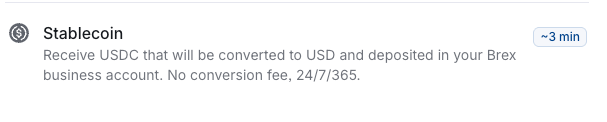
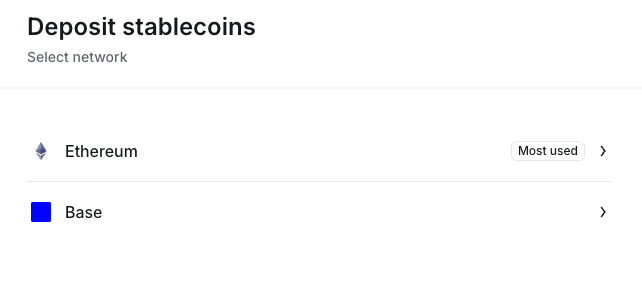
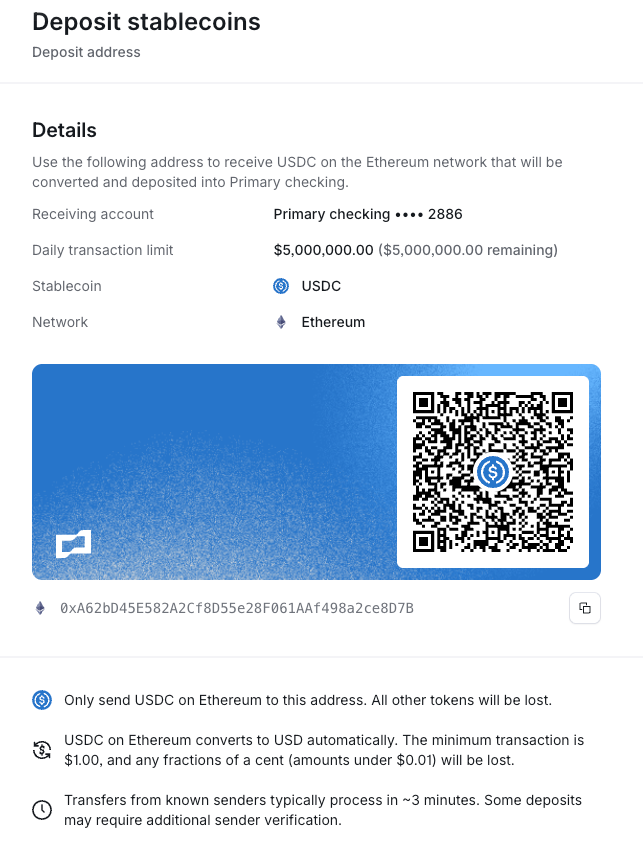
You have to be careful because only USDC is accepted (not USDT, bridged USDC, DAI, etc) on either Ethereum or Base. If the customer messes up any detail, the tokens are lost forever. Thankfully, we haven’t had any issues yet. 🤞🏻
It was so cool receiving my first stablecoin transfer directly into my Brex account. It cut out all the annoying pieces of crypto, such as bridging stablecoins to Coinbase, exchanging them for USD, and then waiting a few days to see the USD in my bank. I didn’t have to worry about losing my private keys and having an emotional meltdown. The risk of sending funds to the wrong address or blockchain is still there, but I heavily communicated the new process to our customers.
The only potential delay with stablecoin payments on Brex is you have to label who the payment is coming from (lightweight KYC) in order for the stablecoins to clear to your checking account. Still, it’s a much more efficient system than what I’ve historically had and I think it’s good practice to identify these payments anyway.
Unfortunately, you can’t pay vendors in stablecoins yet (so I’m still stuck using Coinbase for this), but I’m sure that’s in the pipeline. I know there’s other neo-banks like Meow and Erebor that have these features already, so we’ll be trying out and reporting back on those soon. It’s such a relief and great idea to combine fiat and stablecoins under one banking roof. It makes everything 10x easier for business owners and operators and reduces so many risks, both small and large. I can’t wait to kiss my EOA goodbye and rely fully on my existing banking infra. 💋

.svg)

.svg)

