.svg)
.svg)

.jpg)
.jpg)
.png)
.png)
.svg)
(Before digging into this article, we recommend you read Part One of our 40 Acres Finance series if you’re unfamiliar with the product. The article is not meant to be tax advice, but hopefully it gives readers a useful framework for thinking about 40 Acres in the context of their personal finances. Happy reading!)
40 Acres Finance is a DeFi product that lets users borrow against their veNFT position. The loans are self-repaying and carry no risk of liquidation - the ideal combination! Our first article covered the mechanics of 40 Acres and how to actually use it. This piece will shift gears to talk about the accounting and tax implications of using the protocol (from a US taxpayer perspective).
There is currently no IRS guidance for self-repaying, on-chain loans, so users will need to take a tax position that they’re comfortable with. For gray areas like these, tax is a spectrum and there are more aggressive or more conservative positions to take. Consult your tax professional to come up with a stance you’re willing to defend in case of an IRS audit.
Let’s break down the main on-chain actions and any accounting/tax implications. We’ve already covered several actions on Aerodrome/Velodrome here so this section will focus on 40 Acres activity. The accounting journal entries listed below are conceptual and reflect a GAAP‑style view; for individual taxpayers on a cash basis, you probably don’t have double‑entry books, but the underlying tax concepts (what is income vs loan vs expense) are the same.
#1 Depositing your veNFT into 40 Acres and Getting a USDC Loan Back
From a token flows perspective, the veNFT is “leaving” your wallet but it’s really being held in escrow as collateral. This generally doesn’t trigger any realized gain/loss since the veNFT is still your asset / you have a right to get it back at any time by repaying the loan in full. Using crypto as collateral for a loan is generally not a taxable event unless the collateral is seized, in which case, a deemed sale occurs.
Similarly, the USDC deposit isn’t income since it’s treated as a loan receipt. I think about the journal entries this way:
Depositing the veNFT into a 40 Acres Escrow Contract
Debit Collateral Receivable xx
Credit Crypto Assets xx
Receiving USDC Loan
Debit Stablecoins xx
Prepaid Origination Fees xx → amortized to expense over the life of the loan under GAAP (not applicable to individual tax)
Credit Loan Payable xx
#2 Using the Weekly Rewards Earned from the veNFT to Repay the Loan
This is a tricky area of the tax code. Before diving into tax, here’s how I think about the journal entries:
Rewards earned on Aerodrome/Velodrome
Debit Stablecoins xx
Credit Staking Rewards Income xx
Note, I’m simplifying this entry since rewards earned from your veNFT are technically swapped into USDC by 40 Acres. In our view, it’s impractical for the end user to track these detailed swaps and only the resulting stablecoin rewards should be tracked.
Repaying loan
Debit Loan Payable xx
Debit Lender Fees xx
Debit Protocol Fees xx
Credit Stablecoins xx → the same stablecoins that were earned from rewards
It’s complex because these rewards aren’t technically hitting the user’s wallet. The claiming and repayment is happening behind the scenes in a 40 Acres smart contract. But as the 40 Acres docs say, “Think of your veNFT as revenue generating business” - so the revenue has to be reported/booked somewhere.
The conservative tax position to take is including any rewards claimed from your veNFT (even if by 40 Acres) as taxable income, just as you would for incentives or bribes earned on Aerodrome directly. This income is then immediately going towards paying off debt and fees due to the protocol and lenders. In our view, this could be constructive receipt of income and an accession of wealth. Even though the rewards never touch your wallet, one can argue you have constructive receipt because you control the position that generates them and can alter strategies, repay the loan, or unwind the veNFT, so the economic benefit is effectively yours.
The concept of dominion and control also comes into play here and is a topic worth discussing. In Revenue Ruling 2023‑14, the IRS concluded that staking rewards are includible in gross income in the tax year when the taxpayer gains ‘dominion and control’—that is, when they can sell, exchange, or otherwise dispose of the tokens. In a 40 Acres context, the conservative view is that you have dominion and control when the smart contract claims the rewards on your behalf and applies them to your position, even if you never see them in your wallet (see the constructive receipt point above).
If you’re following this conservative position, the tough part is calculating the rewards claimed since there’s no on-chain transaction happening in your wallet. However, your rewards and repayment history should appear in the 40 Acres UI (head to Borrow → Positions → Activity).
I just entered my position so I haven’t earned any rewards yet, but users should be able to calculate income from here.
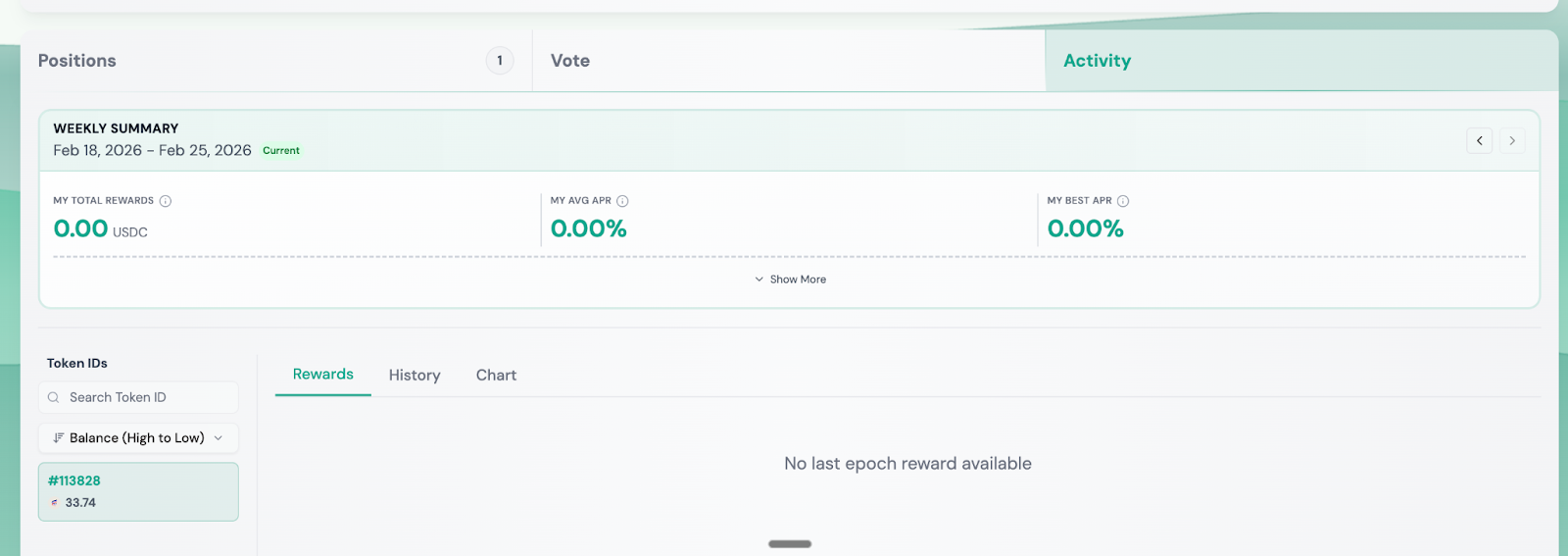
For a business, the fees related to the loan (i.e. lender fees and protocol fees) may be considered deductible expenses, but the same rules typically don’t apply to individuals that are using 40 Acres for personal reasons.
Since tax is a spectrum, a more aggressive position would be to argue that there is no income until you actually receive liquid tokens or cash that you can withdraw, on the theory that the rewards are immediately and irrevocably used to service debt and you never gain dominion over them. This is harder to square with Rev. Rul. 2023‑14 but may be raised by some taxpayers.
#3 Adding and Withdrawing USDC as a Lender
Lender accounting and tax is more straightforward from a token flows perspective:
Depositing USDC into the Pool
Debit Loan Receivable xx
Credit Stablecoins
Practically, this shows up as a trade in your crypto subledger because USDC is leaving your wallet, while VAULT is being deposited. These VAULT tokens represent the loan receivable on your books.
Withdrawing Supplied USDC
Debit Stablecoins xx
Credit Loan Receivable xx
Credit Interest Income
This methodology treats the difference between the initial USDC supplied and the amount withdrawn as interest income, which is ordinary income per the Internal Revenue Code. The only sticky area here relates to the ability to withdraw (mentioned above). The conservative tax position would be to recognize interest income as you’re earning it, regardless of when you’ve actually withdrawn your position.
However, if you’re truly unable to withdraw your entire position because there’s not enough liquidity, that's a more reasonable defense to claim the income upon withdrawing it (versus when it’s earned). Our discussion on dominion and control above exemplifies that point. If the asset is locked (a great example is locked Solana grants), we typically recognize this income upon unlock, since our customer can only sell it/get funds to pay taxes at this future date. But again, welcome to the gray area of crypto tax and accounting! If you have any additional questions, feel free to reach out to us at gm@hashbasis.xyz
Helpful Links:
Aerodrome & Velodrome Protocols Set to Merge in 2026
Diving into Velodrome, the Feature-Rich & Aesthetic DeFi Hub of Optimism

.svg)

.svg)

