.svg)
.svg)

.jpg)
.jpg)
.png)
.png)
.svg)
The DeFi world was electrified a few weeks ago when Dromos Labs, the developer company behind Velodrome and Aerodrome, announced the two protocols were merging into one unified protocol called Aero. We’ve been tracking these protocols for a while now (remember this article we wrote over two years ago? Apparently it’s famous in the Velodrome community now!), so I figured it was time to write a refresher article.
On November 12, Dromos Labs hosted a launch event in New York where they unveiled the merge along with other core features and upgrades as part of Metadex 03, their new dex operating system. The livestream is over six hours long, consisting of “Ted Talk” presentations and fireside chats with ecosystem members (including a surprise message from Vitalik at the end!).
Admittedly, my eyes glazed at some of the more technical topics and revenue charts, but the core message was “The world is coming on-chain” and Aerodrome is going to be the #1 liquidity layer to support this mass migration. I was cheering from the YouTube audience, feeling like a proud mom upon seeing how successful Dromos Labs has become in the twoish years of existence. And tackling entrenched players like Uniswap and Sushiswap successfully, establishing the “right to win” as Alex (CEO of Dromos) called it, is beyond awesome.
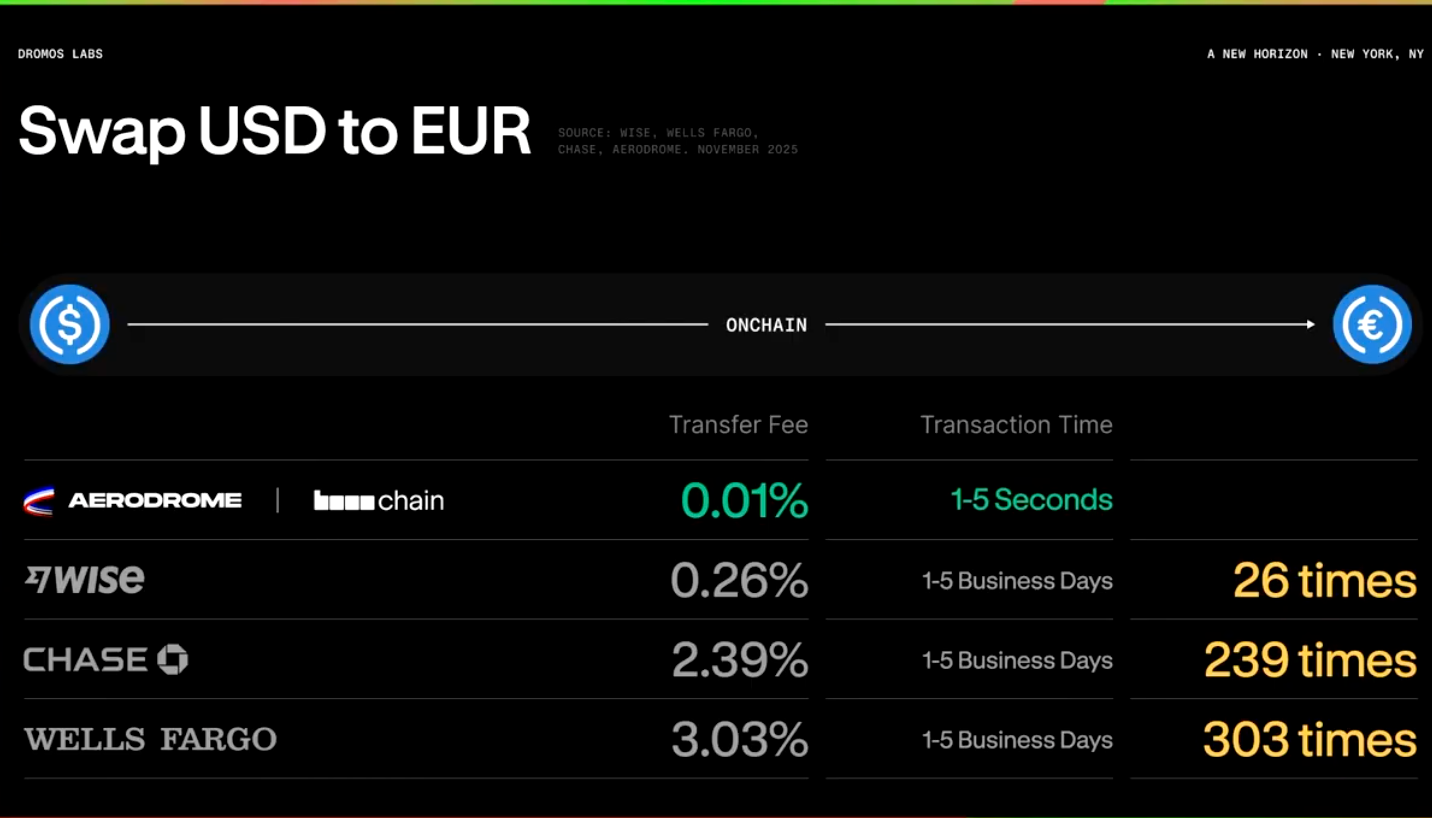
Before getting into the protocol changes, I wanted to highlight some of the stats that Alex shared that prove this on-chain model is working. For example, you can swap USDC to Euros on Velodrome for 0.01% transfer fee and transaction time of 1-5 seconds. This kind of fee and execution time is astonishing compared to web2 companies, even fintech startups like Wise who take on mammoth players like Chase and Wells Fargo.
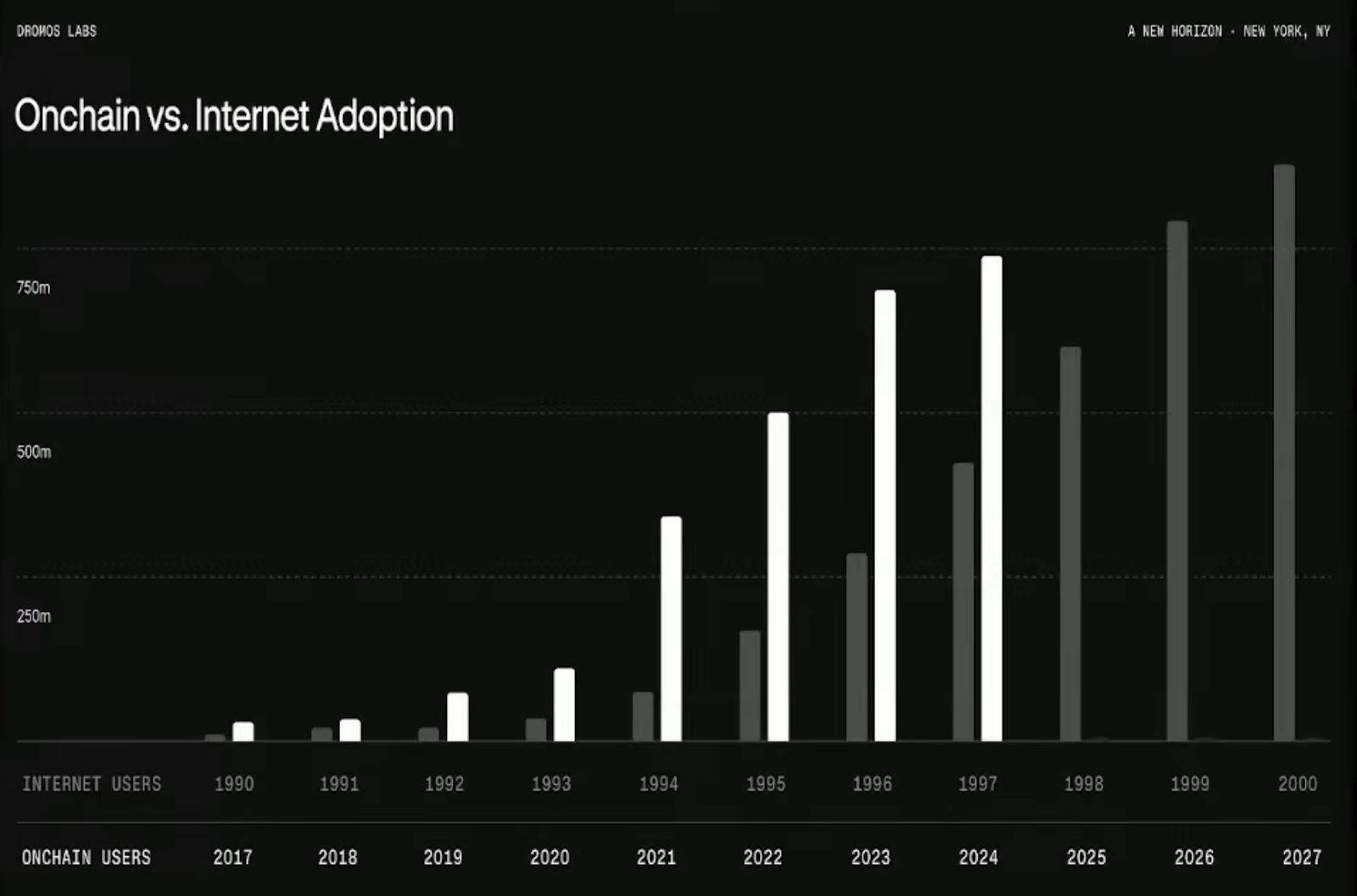
I’m also stunned by this chart the Dromos team shared comparing internet adoption to on-chain adoption. Blockchain activity is clearly growing much faster than the early internet (by over 50% in some years), which perplexed me. Sure, we pay our contractors in crypto once a month, but that’s nothing compared to how often I use the internet (10-12 hours a day). I often think my usage is a proxy for the whole world, but that’s a limited and western-centric view - it turns out I’m just a slow adopter!
Protocol Updates
The protocol-level innovation that makes Aero possible is Metadex 03 (the existing Aerodrome and Velodrome Dapps now are on Metadex 02). Just like blockchains are open-source, immutable and permissionless, Dromos Labs is taking those same characteristics and applying them to the next layer of the DeFi cake - liquidity itself. I’m glad the team flashed an image of how DEXs work because my brain was a little foggy. There are three main players in this on-chain economy:
- Traders - the users actually swapping tokens on the platform; desire best execution prices and times
- Token Operators - holders of the governance token, $AERO; value accrues to this token
- Liquidity Providers - those who provide capital (i.e. liquidity) in order to generate a yield; optimizing for best rewards possible
Aerodrome’s goal is to capture all of the value generated by the platform and redistribute it - with as minimal leakage as possible - to all of the relevant stakeholders. $AERO isn’t meant to be a performative pump & dump token. Rather, it’s a productive liquidity network token that accrues real value to it. This elegant design and theory is encoded into smart contracts that form the Metadex 03 operating system.
There’s two other core ideas to this OS, the AER and REV engines (bear with me, there’s a lot of terminology!):
- REV stands for “Revenue Engine.” This system pulls in additional revenue streams beyond normal swap fees and routes them into the token. Extra revenue includes front‑end fees, bridge fees (metaswaps), aggregator routing fees, Autopilot automation fees, veNFT marketplace fees, launch fees, and Slipstream v3’s internal MEV auctions (we’ll talk about these new revenue buckets in more detail later). Basically, REV = more revenue coming into the system.
- AER is “Adaptive Emissions Rate.” This mechanism makes emissions (the new tokens that are paid out as incentives to LPs and tokenholders) flexible so the system pays just enough (and sometimes temporarily more) for needed liquidity, dramatically lowering effective long‑run dilution. AER = fewer tokens leaving the system unnecessarily (less waste).
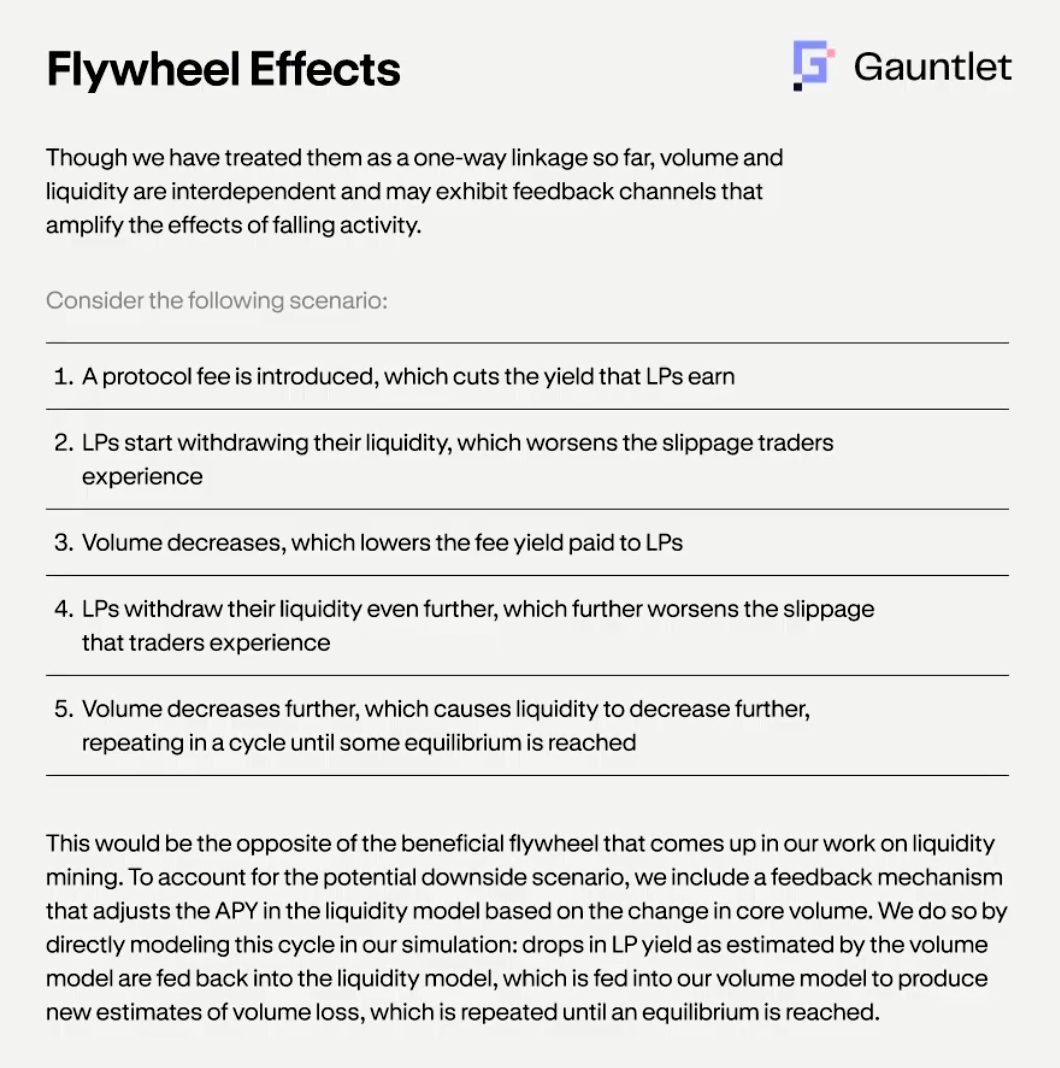
- Overall, this design makes the protocol more efficient with its funds and serves two important purposes: it makes liquidity providers and token operators more incentivized to stay because the rewards are high but it also leads to optimal pricing for traders. In theory, it should prevent the negative flywheel as illustrated in a recent study published by Gauntlet. Put simply, more value is being captured in absolute terms and getting injected back into the community (“maximum value distribution,” as per Alex)
And with this beautiful operating system in place, the platonic ideal of a decentralized exchange can finally be realized in Aero, the merge of the Aerodrome and Velodrome protocols. Originally, I thought these two products were the same but just deployed on different layer twos (Aerodrome on Base and Velodrome on Optimism). However, the team illuminated their different purposes: Velodrome was for the Ethereum ecosystem while Aerodrome was for institutions on base, the blockchain built by Coinbase. By combining these two powerhouses, you get the benefits of both but the simplicity of housing all functionality under one roof. As per the livestream, their goal is to be the number one liquidity layer for the on-chain world, regardless of what chain. Aerodrome won’t just be on Base and Optimism - it’s also coming to mainnet Ethereum and Circle’s Arc chain (more to come in the future).
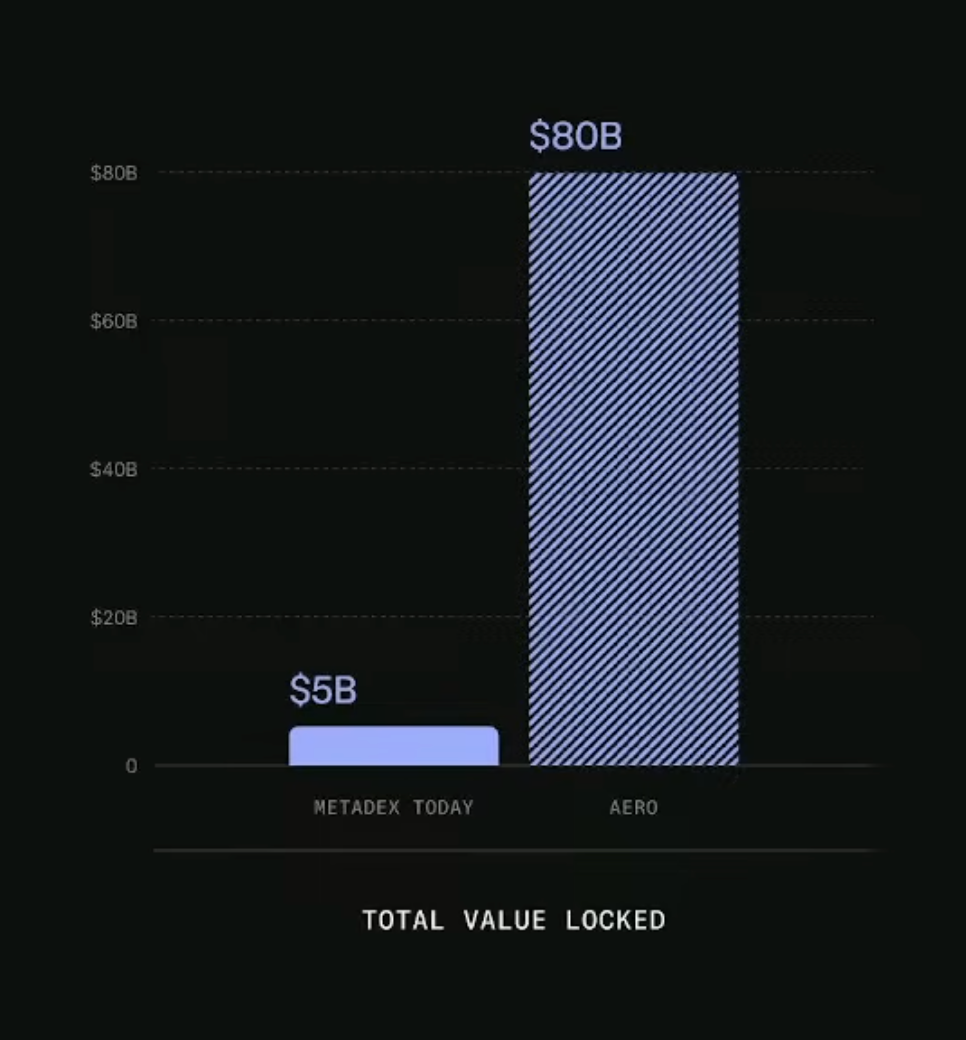
When the event was happening, the TVL (total value locked) opportunity for Metadex 03 was $5B whereas with the new Aerodrome product, this number jumps to an impressive $80B. Wow 🤯
What does this mean for existing $AERO and $VELO token holders? Based on this article, “Aerodrome token holders will receive 94.5% of AERO’s token supply, while Velodrome token holders will receive 5.5%. This proportional distribution reflects the significant activity on Aerodrome while maintaining a role for Velodrome holders in governance and incentives.” Aerodrome has way more TVL and thus more revenue compared to Velodrome, which is why this airdrop isn’t 1:1.*
(* The exact calculation looked at the revenue earned across both protocols for the last 52 weeks, as of announcement date. Aerodrome earned $260m while Velodrome earned $15m - and that’s how you calculate the pro-rate split of the new token!)
The migration is expected to happen in Q2 2026. Most holders should receive the new token automatically, but users with self‑custodied positions, veNFTs, or CEX balances should monitor migration instructions and may need to take action. Based on the details we know so far, this upgrade is analogous to a stock split, meaning the conversion likely wouldn’t be taxable per the IRS. You’re not getting any additional value - you’re just exchanging old tokens for new tokens that are part of a general protocol upgrade (however, this is still an IRS gray area so consult your accountant). Be sure to track your basis in your $AERO, $VELO and veNFT positions meticulously prior to this conversion so you know what cost basis should be carried over.
But this merger is far from the only exciting update that the Dromos team announced - there’s an entire host of new features that are baked in the Metadex 03. We have a laundry list of them below:
- Slipstream v3
- As a reminder, Slipstream is their concentrated liquidity product (i.e. you provide liquidity within certain price bands for higher rewards). In Slipstream v3, an internal MEV auction is built directly into the AMM, and this additional revenue accrues to the token operators and liquidity providers (instead of being diverted to MEV bots).
- As a reminder, MEV is the concept of re-ordering transactions in a block for a fee, and typically this fee auction happens at the sequencer level (the sequencer is the code that compiles layer two transactions down to L1s like Ethereum, which is why transaction re-ordering is such a lucrative business).
- Optimized for institutions
- Metaswaps
- Seamless cross chain swaps have arrived! We don’t have to deal with the terrible bridging UIs and the bridging fees that slowly bleed us to death now. Aerodrome has a native cross chain aggregator and swapper for the entire Ethereum and EVM ecosystem. It doesn’t matter what EVM chain you’re on - you can execute a one-click swap right in the platform.
- Built on typescript SDK, which means other tools and applications can plug into it
- Locked veNFT positions can be traded in the interface as well!
- Autopilot
- Autopilot is the automation suite built for Metadex 03. It optimizes weekly voting rewards across all pools by claiming and compounding rewards from any chain
- Can convert rewards into token of your choice
- Features one-click zapping into different pools (zapping = entering a two-side pool with just one holding, say USDC. The other token pair is acquired via a swap that happens simultaneously upon entering the pool)
- Non custodial
- New Analytics Page
- All positions can be easily seen and digested in a custom dashboard called Cockpit.
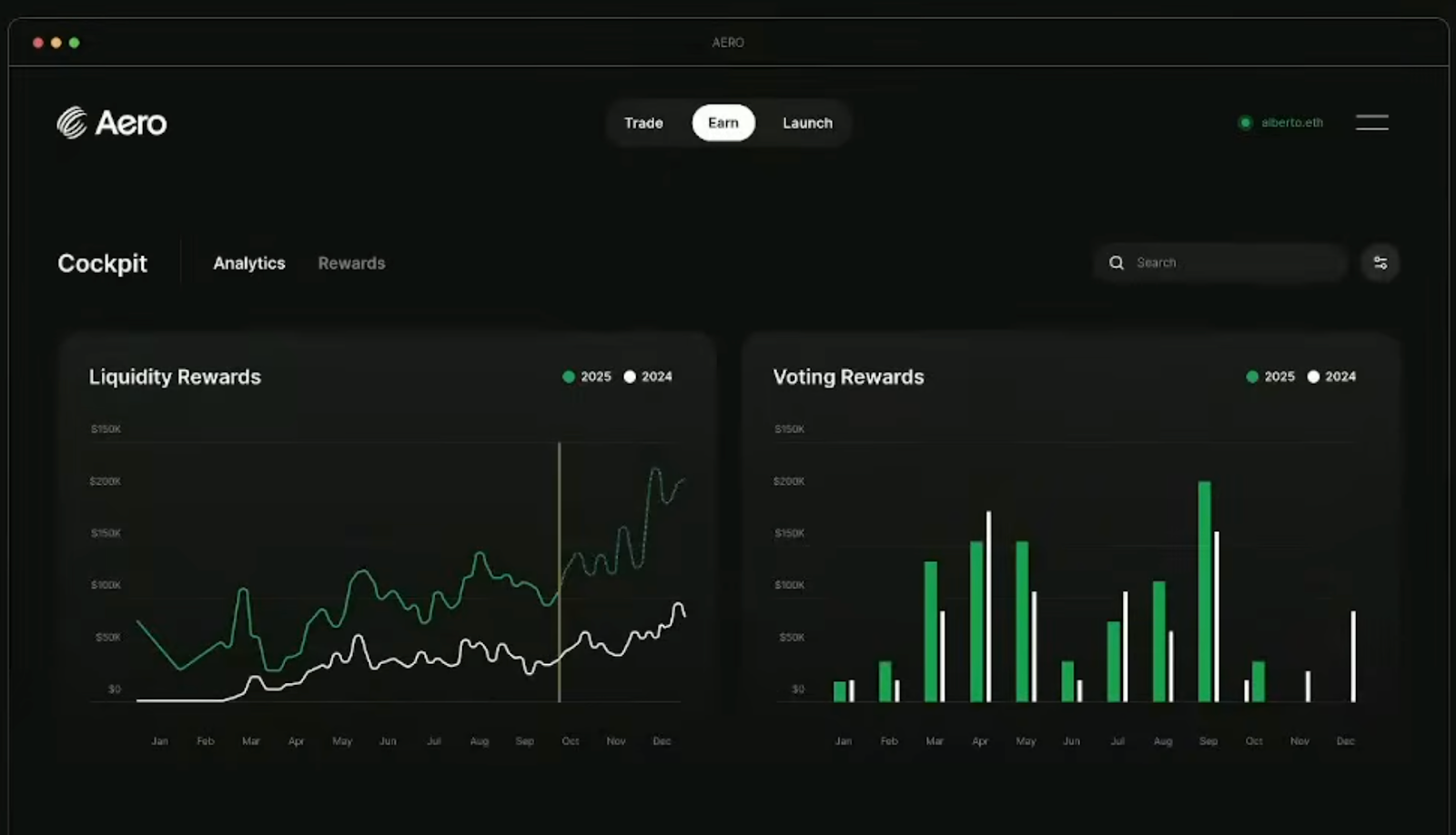
The mockup above shows what the new Aerodrome app will look like, a simplified version of the existing protocols. There are three options at the top: Trade, Earn and Launch.
Trade
This section, as the name suggests, is for all cross chain trading. Gas fees and bridging are abstracted away so tokens (including veNFTs) can be executed simply and quickly. Tokens are routed privately through the metalane for top-grade security and privacy (metalane is the infrastructure that allows cross chain swaps to happen - it’s built on the interchain messaging protocol developed by Hyperlane).
Earn
This is the hub for earning rewards on your capital (i.e. liquidity providers). Autopilot is the star feature here that can be used to rebalance and auto-compound rewards, convert rewards into stablecoins, and zap into positions.
Launch
I find this to be the most intriguing feature because it’s the mechanism for birthing new pools. Let’s say I start a new project, I’ve bootstrapped a community and I’m about to launch a token. I can do this directly on Aerodrome (i.e provide liquidity for both sides of the pool) so people can start buying and trading my token. I don’t have to parlay with centralized exchanges or OTC desks - I can use autonomous smart contracts instead. Per the livestream, there are three levels to this product:
- Aero Launch - permissionless, fee earning pools
- Aero Ignition - community driven launches
- Aero Verified - ZK verified, compliance requirements
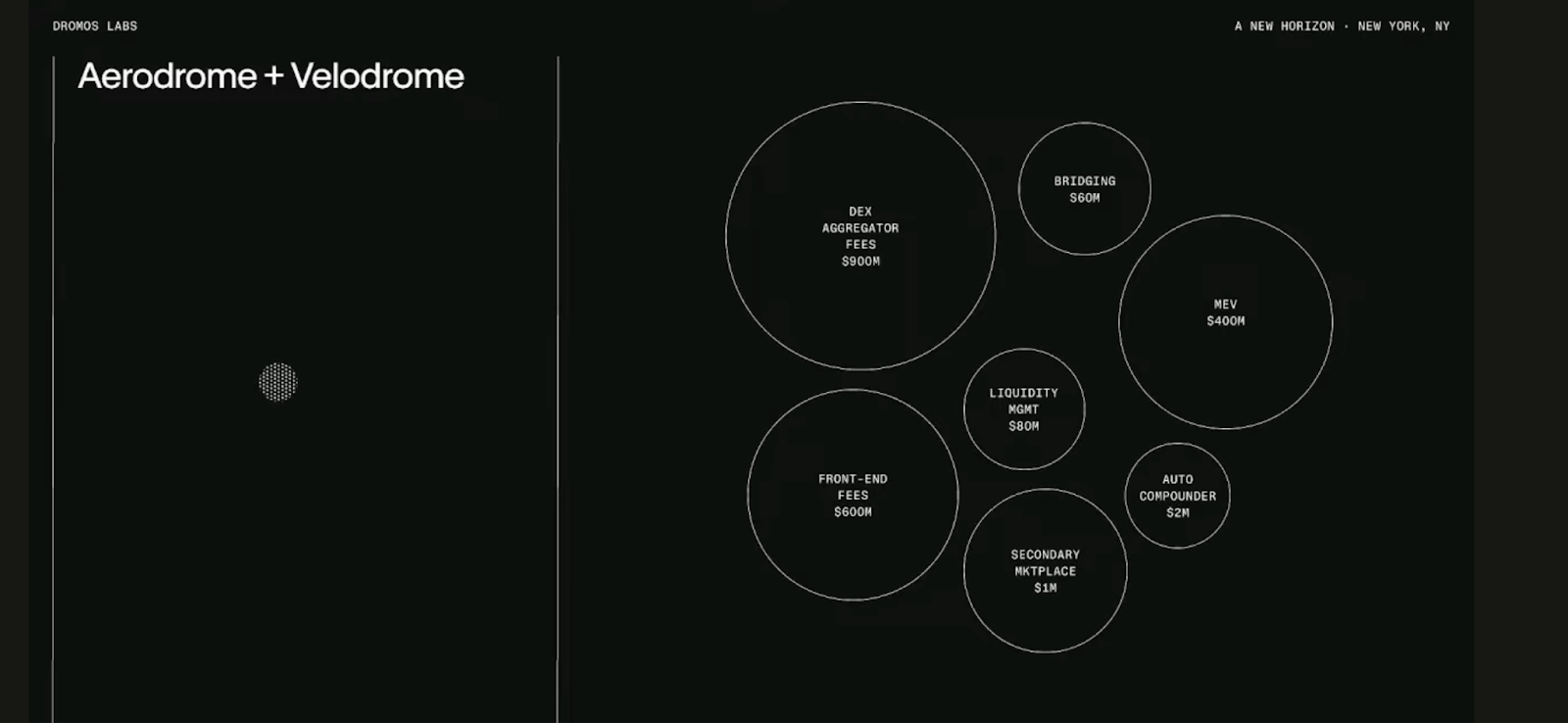
Phew! Now I might’ve missed a few finer details during the six hour playback, but hopefully you have a better understanding of all the revolutions about to happen in DeFi. We are truly on the edge of a yield precipice, and it’s crazy to me that more folks aren’t talking about this (my mom’s crypto friends are still chattering on about XRP). I’ll close with this slide shared by the Dromos Labs team:
I love it because it shows all the real sources of revenue that are being generated, captured and redistributed throughout the Aerodrome ecosystem. I’m thrilled that we finally have a crypto business model that works and a DEX infrastructure that seems sustainable - $AERO isn’t just another crypto scheme, it’s a play at long-term value and practicality. Kudos to the Dromos Labs team and all ecosystem members involved in this effort and success - I can’t wait to see how it unfolds next year. 🌺
Sources
- https://www.youtube.com/watch?v=GO8dt3C4A6g
- https://www.youtube.com/watch?v=Gmu5_ckP3Cc
- https://www.youtube.com/watch?v=pZqbBlLRUtc
- https://thedefiant.io/news/defi/dromos-labs-merges-aerodrome-and-velodrome-into-new-dex-aero
- https://cryptorank.io/news/feed/96bb9-aerodrome-velodrome-merge-token
- https://shine-magazine.com/aero-dromos-labs-redefines-decentralized-exchanges/

.svg)

.svg)

